This website uses cookies. Cookies remember your actions and preferences for a better online experience.




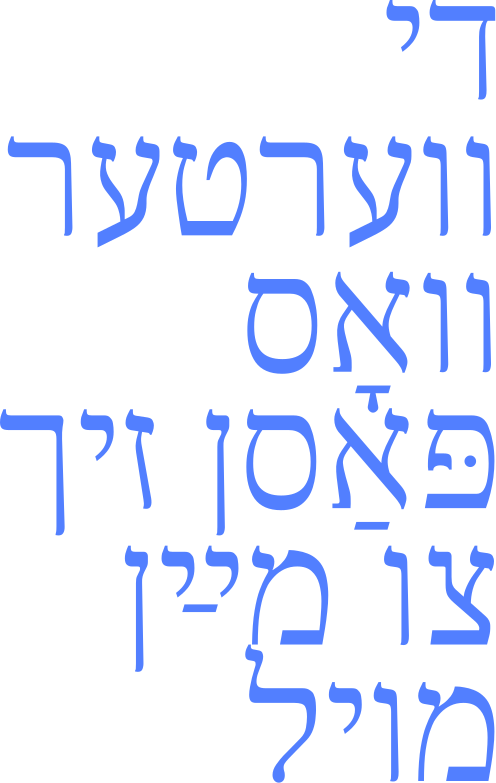
Exhibition The Words That Fit My Mouth brings together artists whose works engage with embodied translation, interpretation, and multilingual transtemporalities. Responding to Jewish tradition of reading and commentary, the exhibition approaches texts not as fixed containers of meaning, but as spaces shaped through contradiction, repetition, and reimagining. Meaning emerges through layered encounters in which divergent voices remain in relation to one another rather than being reconciled.
The exhibition includes works that move between languages — Yiddish, Hebrew, Arabic, and others. These acts of translation do not seek perfect equivalence, but instead reveal both the productive and problematic instability of language and transmission. Translation here extends beyond the linguistic domain: it appears through gesture, movement, textiles, sound, ritual, and forms of embodied memory. The exhibition turns into a site of multivocality, sustained through accumulation, fragmentation, and the coexistence of voices held simultaneously in tension.
Arndt Beck’s work ikh bin nisht maksim | I disagree (2025), is a part of a larger collective artistic research project initiated by Beck honors the Yiddish feminist and anarchist activist Milly Witkop (1877–1955). Beck’s multi-lingual mail art installation explores and reactivates the legacy of Witkop and connects the language(s) of the past and present – the clarity of the vernacular of turn-of-the century anarchism to the dialects of the post-ideological present. The work unfolds through circulation and participation: visitors are invited to take, alter, and/or send postcards addressed to Witkop’s last known address in Berlin, transforming the installation into an evolving network of remembrance and collective exchange across languages, places, and generations.
In Liliana Farber’s Songs for Rivers Silkscreen monoprints (2024) Yiddish poems about rivers, found in Yizkor Books (memorial books commemorating a Jewish community destroyed during the Holocaust), are arranged to follow the shapes of the rivers they celebrate and printed as silkscreens using excess water. Farber offers a visual experiment of translation between a language and nature and matter, between letterforms and streams and tides. Accompanying the prints, recordings of the poems being read aloud in Yiddish by different contemporary voices fill the space, transforming the installation into a living sonic environment. The work reconnects language to breath, memory, and landscape, allowing the rhythms of Yiddish poetry to circulate through the room like water itself.
Laila Abd Elrazaq presents a series of recent video works across two exhibition spaces. In the main exhibition space, What’s your mother tongue? (2022) reflects on language, belonging, and identity through the artist’s personal relationship to Arabic, Hebrew, and English. In the Kabbalist Room, Old-fashioned (2025) explores the future of the Arabic language within Palestinian and Israeli communities. Based on interviews with Arabic speakers from Christian, Muslim, Bedouin, Druze, and mixed backgrounds, the work presents conflicting perspectives, with some fearing Arabic’s decline as Hebrew and English dominate, while others believe younger generations will preserve it. Alongside it, Linguistic Limbo (2024) and Aren’t you ashamed of yourself? (2023) examine multilingual identity, linguistic shame, and cultural alienation through fragmented autobiographical narratives and unsettling audio-visual collages.
Masha Shprayzer’s Lyulinke, mayn feygele (2026) is an installation composed of found textiles, sewing, and acrylic paint on vintage domestic fabrics, pillowcases, and fragments of twentieth-century household cloth. Suspended in space like a fragile portal or the threshold to a folktale, the work layers fabrics that have already been repeatedly repaired and mended across generations. Drawing from Yiddish lullabies and songs, the installation reflects on memory, migration, women’s experience, and the persistence of fragile emotional histories carried through domestic labor, repetition, and acts of care. The inclusion of found lace also evokes the long tradition of Venetian and Burano lace-making — a centuries-old craft historically practiced by women and passed down through generations in the lagoon communities around Burano. By combining inherited textile fragments with gestures of repair and stitching, the work connects personal and diasporic memory to broader histories of feminine labor, ornament, and survival.
The exhibition is accompanied by a series of performances by artist, choreographer, and singer Eliana Pliskin Jacobs. Dancing between displacements / Tantsn tsvishn na un nad (2026) is a partially-improvised, site-specific interactions blending sound, movement and physical expression, language and public dialogue. Wearing an outfit inspired by traditional women’s clothing of the no-longer-existent shtetls of Yiddishland, the artist places herself in public space and interacts with public patterns of movement. Performed in Yiddish and English in the spaces of the Venice Biennale, Venecial Ghetto, and other public spaces of Venice, Dancing between displacements / Tantsn tsvishn na un nad connects the layered history of Venice with that of Yiddish culture.
Yiddishland Pavilion is a conceptual, independent, non-national pavilion initiated in 2022 by artist Yevgeniy Fiks and curator Maria Veits, presented in parallel with La Biennale di Venezia. Since 2025, the pavilion has been situated in the Ghetto Vecchio in collaboration with Venezia Contemporanea and Scalamata. Shaped by both historic and contemporary Yiddish experiences, the pavilion proposes Yiddishland as a shared cultural and artistic platform that transcends national borders and fixed geographies. For its third iteration, the pavilion explores Yiddishland as an imagined territory constituted through language, translation, memory, and the politics of voice.
The exhibition includes works that move between languages — Yiddish, Hebrew, Arabic, and others. These acts of translation do not seek perfect equivalence, but instead reveal both the productive and problematic instability of language and transmission. Translation here extends beyond the linguistic domain: it appears through gesture, movement, textiles, sound, ritual, and forms of embodied memory. The exhibition turns into a site of multivocality, sustained through accumulation, fragmentation, and the coexistence of voices held simultaneously in tension.
Arndt Beck’s work ikh bin nisht maksim | I disagree (2025), is a part of a larger collective artistic research project initiated by Beck honors the Yiddish feminist and anarchist activist Milly Witkop (1877–1955). Beck’s multi-lingual mail art installation explores and reactivates the legacy of Witkop and connects the language(s) of the past and present – the clarity of the vernacular of turn-of-the century anarchism to the dialects of the post-ideological present. The work unfolds through circulation and participation: visitors are invited to take, alter, and/or send postcards addressed to Witkop’s last known address in Berlin, transforming the installation into an evolving network of remembrance and collective exchange across languages, places, and generations.
In Liliana Farber’s Songs for Rivers Silkscreen monoprints (2024) Yiddish poems about rivers, found in Yizkor Books (memorial books commemorating a Jewish community destroyed during the Holocaust), are arranged to follow the shapes of the rivers they celebrate and printed as silkscreens using excess water. Farber offers a visual experiment of translation between a language and nature and matter, between letterforms and streams and tides. Accompanying the prints, recordings of the poems being read aloud in Yiddish by different contemporary voices fill the space, transforming the installation into a living sonic environment. The work reconnects language to breath, memory, and landscape, allowing the rhythms of Yiddish poetry to circulate through the room like water itself.
Laila Abd Elrazaq presents a series of recent video works across two exhibition spaces. In the main exhibition space, What’s your mother tongue? (2022) reflects on language, belonging, and identity through the artist’s personal relationship to Arabic, Hebrew, and English. In the Kabbalist Room, Old-fashioned (2025) explores the future of the Arabic language within Palestinian and Israeli communities. Based on interviews with Arabic speakers from Christian, Muslim, Bedouin, Druze, and mixed backgrounds, the work presents conflicting perspectives, with some fearing Arabic’s decline as Hebrew and English dominate, while others believe younger generations will preserve it. Alongside it, Linguistic Limbo (2024) and Aren’t you ashamed of yourself? (2023) examine multilingual identity, linguistic shame, and cultural alienation through fragmented autobiographical narratives and unsettling audio-visual collages.
Masha Shprayzer’s Lyulinke, mayn feygele (2026) is an installation composed of found textiles, sewing, and acrylic paint on vintage domestic fabrics, pillowcases, and fragments of twentieth-century household cloth. Suspended in space like a fragile portal or the threshold to a folktale, the work layers fabrics that have already been repeatedly repaired and mended across generations. Drawing from Yiddish lullabies and songs, the installation reflects on memory, migration, women’s experience, and the persistence of fragile emotional histories carried through domestic labor, repetition, and acts of care. The inclusion of found lace also evokes the long tradition of Venetian and Burano lace-making — a centuries-old craft historically practiced by women and passed down through generations in the lagoon communities around Burano. By combining inherited textile fragments with gestures of repair and stitching, the work connects personal and diasporic memory to broader histories of feminine labor, ornament, and survival.
The exhibition is accompanied by a series of performances by artist, choreographer, and singer Eliana Pliskin Jacobs. Dancing between displacements / Tantsn tsvishn na un nad (2026) is a partially-improvised, site-specific interactions blending sound, movement and physical expression, language and public dialogue. Wearing an outfit inspired by traditional women’s clothing of the no-longer-existent shtetls of Yiddishland, the artist places herself in public space and interacts with public patterns of movement. Performed in Yiddish and English in the spaces of the Venice Biennale, Venecial Ghetto, and other public spaces of Venice, Dancing between displacements / Tantsn tsvishn na un nad connects the layered history of Venice with that of Yiddish culture.
Yiddishland Pavilion is a conceptual, independent, non-national pavilion initiated in 2022 by artist Yevgeniy Fiks and curator Maria Veits, presented in parallel with La Biennale di Venezia. Since 2025, the pavilion has been situated in the Ghetto Vecchio in collaboration with Venezia Contemporanea and Scalamata. Shaped by both historic and contemporary Yiddish experiences, the pavilion proposes Yiddishland as a shared cultural and artistic platform that transcends national borders and fixed geographies. For its third iteration, the pavilion explores Yiddishland as an imagined territory constituted through language, translation, memory, and the politics of voice.
Arndt Beck's work ikh bin nisht maksim | I disagree (2025)
In Liliana Farber’s Songs for Rivers Silkscreen monoprints (2024)
Old-fashioned (2025)
Masha Shprayzer’s Lyulinke, mayn feygele (2026)
Dancing between displacements / Tantsn tsvishn na un nad (2026)


The exhibition is accompanied by a series of performances by choreographer and singer Eliana Pliskin Jacobs. Dancing between displacements / Tantsn tsvishn na un nad is a partially-improvised, site-specific series of interactions blending sound, movement and physical expression, language and public dialogue. Wearing an outfit inspired by traditional women’s clothing of the no-longer-existent shtetls of Yiddishland, the artist places herself in public space and interacts with public patterns of movement.
Masha Shprayzer’s Lyulinke, mayn feygele (2026) is an installation composed of found textiles, sewing, and acrylic paint on vintage domestic fabrics, pillowcases, and fragments of twentieth-century household cloth. Suspended in space like a fragile portal or the threshold to a folktale, the work layers fabrics that have already been repeatedly repaired and mended across generations. Drawing from Yiddish lullabies and songs, the installation reflects on memory, migration, women’s experience, and the persistence of fragile emotional histories carried through domestic labor, repetition, and acts of care. The inclusion of found lace also evokes the long tradition of Venetian and Burano lace-making — a centuries-old craft historically practiced by women and passed down through generations in the lagoon communities around Burano. By combining inherited textile fragments with gestures of repair and stitching, the work connects personal and diasporic memory to broader histories of feminine labor, ornament, and survival.
Laila Abd Elrazaq presents a series of recent video works across two exhibition spaces. In the main exhibition space, What’s your mother tongue? (2022) reflects on language, belonging, and identity through the artist’s personal relationship to Arabic, Hebrew, and English. In the Kabbalist Room, Old-fashioned (2025) explores the future of the Arabic language within Palestinian and Israeli communities. Based on interviews with Arabic speakers from Christian, Muslim, Bedouin, Druze, and mixed backgrounds, the work presents conflicting perspectives, with some fearing Arabic’s decline as Hebrew and English dominate, while others believe younger generations will preserve it. Alongside it, Linguistic Limbo (2024) and Aren’t you ashamed of yourself? (2023) examine multilingual identity, linguistic shame, and cultural alienation through fragmented autobiographical narratives and unsettling audio-visual collages.
In Liliana Farber’s Songs for Rivers Silkscreen monoprints (2024), Yiddish poems about rivers, found in Yizkor Books (memorial books commemorating a Jewish community destroyed during the Holocaust), are arranged to follow the shapes of the rivers they celebrate and printed as silkscreens using excess water. Farber offers a visual experiment of translation between a language and nature and matter, between letterforms and streams and tides. Accompanying the prints, recordings of the poems being read aloud in Yiddish by different contemporary voices fill the space, transforming the installation into a living sonic environment. The work reconnects language to breath, memory, and landscape, allowing the rhythms of Yiddish poetry to circulate through the room like water itself.
Arndt Beck’s work ikh bin nisht maskim | I disagree (2025) is a part of a larger collective artistic research project initiated by Beck honors the Yiddish feminist and anarchist activist Milly Witkop (1877–1955). Beck’s multi-lingual mail art installation explores and reactivates the legacy of Witkop and connects the language(s) of the past and present – the clarity of the vernacular of turn-of-the century anarchism to the dialects of the post-ideological present. The work unfolds through circulation and participation: visitors are invited to take, alter, and/or send postcards addressed to Witkop’s last known address in Berlin, transforming the installation into an evolving network of remembrance and collective exchange across languages, places, and generations.
The Words That Fit My Mouth brings together artists whose works engage with embodied translation, interpretation, and multilingual transtemporalities. Responding to Jewish tradition of reading and commentary, the exhibition approaches texts not as fixed containers of meaning, but as spaces shaped through contradiction, repetition, and reimagining. Meaning emerges through layered encounters in which divergent voices remain in relation to one another rather than being reconciled.
The exhibition includes works that move between languages — Yiddish, Hebrew, Arabic, and others. These acts of translation do not seek perfect equivalence, but instead reveal both the productive and problematic instability of language and transmission. Translation here extends beyond the linguistic domain: it appears through gesture, movement, textiles, sound, ritual, and forms of embodied memory. The exhibition turns into a site of multivocality, sustained through accumulation, fragmentation, and the coexistence of voices held simultaneously in tension.
The exhibition includes works that move between languages — Yiddish, Hebrew, Arabic, and others. These acts of translation do not seek perfect equivalence, but instead reveal both the productive and problematic instability of language and transmission. Translation here extends beyond the linguistic domain: it appears through gesture, movement, textiles, sound, ritual, and forms of embodied memory. The exhibition turns into a site of multivocality, sustained through accumulation, fragmentation, and the coexistence of voices held simultaneously in tension.