The Castle of Yiddishland
Anna Kamyshan
AI-generated video, 1:17
Inspired by René Magritte’s “The Castle of the Pyrenees”, the project by Anna Kamyshan echoes his vision of safekeeping in free suspension. Here, the Castle is a lost wooden synagogue—the spiritual and communal heart of Eastern European shtetls—drifting above the cities of today’s dispersed Yiddishland. Each synagogue’s architecture adapts to its surroundings, merging local forms with the memory of vanished Jewish spaces. The work reclaims airspace as territory, recalling how Jews in Venice were forbidden to build synagogues on the ground floor, raising them above the city. In perpetual flight, these synagogues evoke a homeland without land—resilient, adaptive, and borderless.
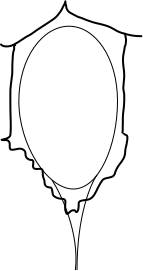
Illustration from the 1957 book "Wooden Synagogues" and the 1996 edition "Heaven's Gates: Wooden Synagogues".


René Magritte, The Castle of the Pyrenees, 1959, Israel Museum, Jerusalem
Nabatele:
from an idea in 2024 to materialization in 2026
from an idea in 2024 to materialization in 2026
Anna Kamysan’s project was never meant to remain a just proposal or a digital artwork. From the beginning, the artist intended to build it in the physical world. In 2026 that intention has taken shape as Nabatele, a large-scale public installation presented as a Collateral Event of the 61st International Art Exhibition La Biennale di Venezia in collaboration with the Montreal Jewish Museum.
This time, the synagogue is neither a projection nor a rendering. It appears in the flesh above Arsenale Nord, suspended over the threshold between the historic dockyards and the open lagoon. Once a site of industrial production and naval power, Arsenale Nord now stands in transition with its vast structures carrying traces of labor, abandonment, and renewal. The synagogue is exposed to wind, weather, and shifting light. It does not anchor itself to the ground. Instead of claiming land, it inhabits airspace remaining responsive to its environment.
Presented as a non-national collateral event within the framework of the Venice Biennale, Nabatele materializes this condition spatially. Suspended above the terrain of national pavilions, it hovers, literally and symbolically, over the divisions that structure the Biennale itself. Its refusal to anchor in the ground parallels Yiddishland’s own non-territorial logic: a cultural sphere sustained not by borders but by language, memory, and transmission. Fluid and nomadic, the project is conceived to travel beyond Venice to other sites within Yiddishland, continuing to float above permanence and resisting fixation within a single geography.
Nabatele is on view in July - September 2026.
This time, the synagogue is neither a projection nor a rendering. It appears in the flesh above Arsenale Nord, suspended over the threshold between the historic dockyards and the open lagoon. Once a site of industrial production and naval power, Arsenale Nord now stands in transition with its vast structures carrying traces of labor, abandonment, and renewal. The synagogue is exposed to wind, weather, and shifting light. It does not anchor itself to the ground. Instead of claiming land, it inhabits airspace remaining responsive to its environment.
Presented as a non-national collateral event within the framework of the Venice Biennale, Nabatele materializes this condition spatially. Suspended above the terrain of national pavilions, it hovers, literally and symbolically, over the divisions that structure the Biennale itself. Its refusal to anchor in the ground parallels Yiddishland’s own non-territorial logic: a cultural sphere sustained not by borders but by language, memory, and transmission. Fluid and nomadic, the project is conceived to travel beyond Venice to other sites within Yiddishland, continuing to float above permanence and resisting fixation within a single geography.
Nabatele is on view in July - September 2026.
Anna Kamyshan
Anna Kamyshan is a multidisciplinary curator, artist and architect.
From 2019 to 2021 Anna was a Director of Conceptual Development at Babyn Yar Holocaust Memorial Center in Kyiv. Under her creative direction, a 100-year plan for the Babyn Yar territory was developed, focused around a number of installations and architectural interventions. Anna is the author of installation Glimpse into the Past dedicated to the oblivion of memory. Anna was a member of the Architectural Advisory Board of the Babyn Yar Foundation.
Anna curated the Moscow River project at the Meganom architectural practice in 2014-2019 and co-founded the grassroots public organisation Moscow River Friends. This initiative helped to build awareness about the long-lasting crisis of the river and the state’s role in exacerbating it. The exhibition resulting from the project won the Wax Bee prize at the 2019 Milan Triennial and was part of the Venice Biennale publication project Voices, awarded with a Special Mention.
From 2019 to 2021 Anna was a Director of Conceptual Development at Babyn Yar Holocaust Memorial Center in Kyiv. Under her creative direction, a 100-year plan for the Babyn Yar territory was developed, focused around a number of installations and architectural interventions. Anna is the author of installation Glimpse into the Past dedicated to the oblivion of memory. Anna was a member of the Architectural Advisory Board of the Babyn Yar Foundation.
Anna curated the Moscow River project at the Meganom architectural practice in 2014-2019 and co-founded the grassroots public organisation Moscow River Friends. This initiative helped to build awareness about the long-lasting crisis of the river and the state’s role in exacerbating it. The exhibition resulting from the project won the Wax Bee prize at the 2019 Milan Triennial and was part of the Venice Biennale publication project Voices, awarded with a Special Mention.